LATTICE Management / AI & Emerging Technology
How Does AI Know Your Website Exists?
Learn how AI discovers businesses online, what an llms.txt file does, and how to prepare your website for an evolving world of AI search.
How do AI assistants discover your business?
AI assistants such as ChatGPT, Perplexity and Gemini answer questions using information they can find and read publicly. They draw on search indexes, their own web crawlers, and licensed or publicly available data sources.
If your website cannot be crawled, or your business information is thin, outdated or inconsistent across the web, an assistant has very little reliable material to work with. It may skip your business entirely or repeat outdated details.
- Assistants rely on public pages they can fetch and read.
- They cross-check your website against directories, profiles and reviews.
- Clear, structured and current information is easier for them to use correctly.
What roles do crawling, indexing and structured data play?
Crawling is how bots fetch your pages. Indexing is how search engines store and organize what they find. Structured data is machine-readable labeling, usually schema.org markup, that states what a page is about: a business, a service, an article, an address.
Your robots.txt file tells crawlers what they may access, and your XML sitemap lists the pages you consider important. Together with structured data, these files are how you introduce your website to machines in an orderly way.
- robots.txt controls what may be crawled.
- An XML sitemap lists your important pages.
- Structured data states what each page is about, in a format machines trust.
What is an llms.txt file?
An llms.txt file is a plain text file, written in Markdown, that sits at the root of your website. It lists the pages and information you want AI systems to notice first, with short descriptions of what each page contains.
Think of it as a curated table of contents for language models, similar in spirit to how robots.txt speaks to crawlers. You can see the one for this website at /llms.txt.
An important honesty note: llms.txt is an emerging convention, not an adopted standard. Publishing one does not guarantee AI visibility, recommendations, indexing or rankings. It is one tidy signal among many, and the fundamentals below still do most of the work.
How can llms.txt organize your important pages?
The format is simple. Start with your business name as a heading, add a one-sentence summary as a blockquote, then group links under clear sections such as Services, Company and Resources. Each link gets a short description so a reader, human or machine, knows what is behind it.
The goal is curation, not volume. List the pages that best explain what your business does, who it serves and how to contact it. Leave out thin or duplicate pages.
How do you create and publish the file?
Create a plain text file named llms.txt and place it at the root of your website so it is reachable at yourdomain.com/llms.txt without a login. Keep it in Markdown, keep descriptions short, and update it when your important pages change.
Here is a basic example you can copy and adapt:
# Acme Plumbing

> Acme Plumbing provides residential plumbing repair and installation in Springfield.

## Services
- [Services](https://example.com/services): Full list of plumbing services
- [Emergency repairs](https://example.com/emergency): Around-the-clock repair information

## Company
- [About](https://example.com/about): Company history and team
- [Contact](https://example.com/contact): Phone, email and service area
How do you check crawlability and discoverability?
Start with the basics. Search for your business name and see what appears. Confirm your robots.txt is not accidentally blocking crawlers, and submit your sitemap through Google Search Console and Bing Webmaster Tools so both indexes know your pages.
Then check the consistency layer: your Google Business Profile, major directories and social profiles should all show the same name, address, phone number and website. AI systems cross-check these sources, and contradictions reduce confidence.
- Search your business name and review what comes up.
- Verify robots.txt allows the pages that matter.
- Submit your sitemap to Google Search Console and Bing Webmaster Tools.
- Make your name, address, phone and website identical everywhere.
Why do technical SEO and accurate information still matter?
An llms.txt file is one small file. Fast pages, useful content, accurate business information, genuine reviews and clear service descriptions remain the foundation of being found, by search engines and by AI assistants alike.
Common mistakes worth avoiding: blocking important pages in robots.txt, letting listings drift out of date, publishing thin pages that say nothing specific, and expecting any single file to change your visibility on its own.
AI Isn't Standing Still. Neither Should Your Business.
Join our free educational email series and learn how AI discovers websites, how to improve your online presence, and what new developments could mean for your business. The free guide is delivered as a five-part email series.
- ImmediatelyHow AI Finds Your Website
- Day 2Creating Your llms.txt File
- Day 5Checking Your Business's AI Discoverability
- Day 8Technical Website Improvements
- Day 12When Your Website Needs More Than an llms.txt File
Paid Option
What Does AI Actually Understand About Your Website?
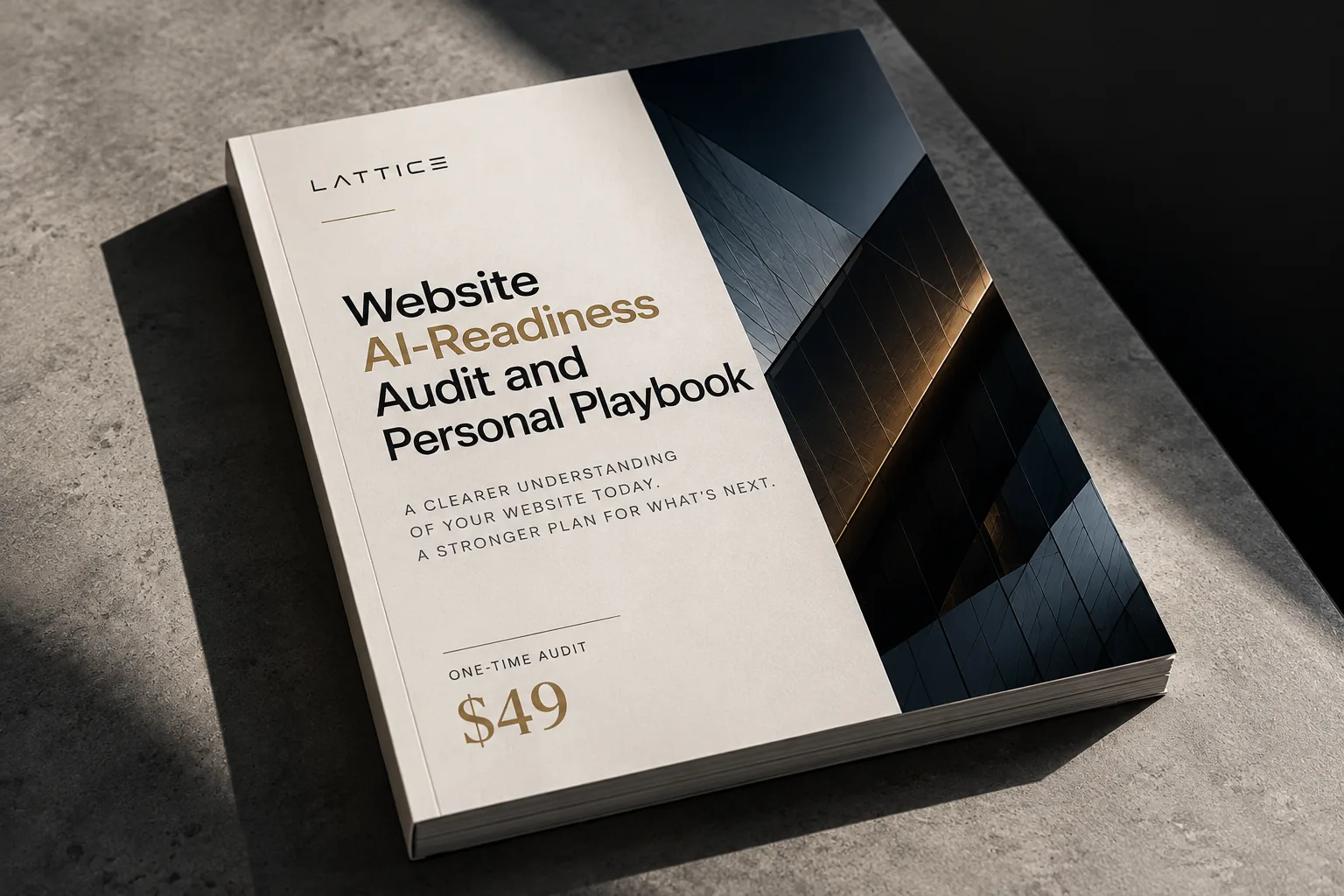
$49 One-Time Website Audit
Is your website ready for the future of AI-powered search? For just $49, LATTICE will review your website to evaluate how easily AI tools and search engines can discover, access, and understand your business. We'll assess your website's technical setup, content structure, indexing, structured data, and AI-readiness, then deliver a personalized action playbook outlining what's working, what's missing, and exactly what you can do to improve. Your $49 investment doesn't have to stop there. If you decide to build or rebuild your website with LATTICE, we'll credit the full $49 toward your eligible website project.
- Website crawlability and indexing review
- Sitemap and robots.txt review
- llms.txt assessment
- Structured data review
- Business information consistency
- AI search discoverability spot checks
- Prioritized written recommendations
Includes Website Credit.
We take $49 off any website build. We will email you the code after enrollment. The credit is applied once, is not redeemable for cash, and cannot be combined with other promotions unless approved.
You go straight to a secure payment page. Nothing is collected on this page.